H3 Max Recast swaps the people in a video for the people in your photos. You give it a clip and one photo per person; it gives the clip back with the same moves, the same camera and the same sound, and someone else in it. We ran it twelve times. The swap holds, speech stays in sync, the seed brings the same take back, and the photo decides more than you would think.
Tested November 2, 2026: seven runs through Tonpit, two of them refused on purpose, and five straight on fal, on three five-second clips made with FLUX 3 Max. Every time and price here is from those jobs. The prompts are printed in full at the end.
What is H3 Max Recast, in short?
- A people-swap for existing video. Made by fal on its H3 Max video model, released October 2026, on fal only.
- It takes a clip and photos. Five to thirty seconds of video and one photo per person to put in, up to four. A prompt is optional.
- Everything but the people stays. Motion, camera, length and the sound track come back untouched.
- The whole person is replaced, clothes included. What your photo shows is what you get; what it cuts off, the model invents.
- Speech survives. A new face says the original words, lips on the beat.
- The seed replays. The same seed gives the same clip back.
- About a minute and a half to two minutes, and $2.25, for a five-second clip at 720p in Tonpit.
What did we run?
Three source clips, each five seconds and one shot: a woman dancing in a kitchen, two executives arm-wrestling, and a man saying a line to camera. The replacements were generated photos: a grandpa, a nun and a metal drummer, plus one real selfie.
| Run | Clip and photos | Settings | Time | Cost | Landed | Missed |
|---|---|---|---|---|---|---|
| 1 | Dance, grandpa head crop, no prompt | 1080p | 90 s | $3.38 | The dance, the room, the music. Face, glasses and cardigan from the photo. | Trousers invented; the photo stopped at the chest. |
| 2 | Dance, a three-view image of the grandpa, no prompt | 720p | 123 s | $2.25 | Full outfit down to the shoes. | |
| 3 | Arm wrestle, nun and drummer, prompt says who is who | 720p | 107 s | $2.25 | The prompt’s assignment, both outfits, the slam, the sound. | |
| 4 | Dance, grandpa, same seed twice (on fal) | 720p | 84 s, 100 s | $2.25 each | The same clip both times. | |
| 5 | Dance, grandpa, realism switch off, same seed (on fal) | 720p | 111 s | $2.25 | Another take of the same dance, no better and no worse. | |
| 6 | Desk line, nun, no prompt | 720p | 87 s | $2.25 | Her lips on his words, his voice untouched. | |
| 7 | Dance, a real photo, no prompt | 720p | 93 s | $2.25 | Accepted. The real face dances. | |
| 8 | Desk line, the real photo, realism switch on and off, same seed (on fal) | 720p | 117 s each | $2.25 each | On: the face takes the lamp light. Off: it keeps the photo’s flat light. | |
| 9 | A 4-second clip, then a 31-second one | 720p | $0 | Both refused before any charge. |
Time is from pressing generate to having the file. Cost is what the clip costs in Tonpit; the runs made straight on fal are priced here as they would be in Tonpit.
What do you give H3 Max Recast?
A video, one photo per person, and optionally a sentence. The video must be five to thirty seconds, with no single shot longer than fifteen. The photo should show the person front-on, on a plain background. The output comes at 720p or 1080p, at the clip's own length and shape. With no prompt, the photos replace the main people from left to right.
Which photo works best for a recast?
One that shows the whole person. The photo's frame is the outfit's frame: whatever it shows comes over, and whatever it cuts off is made up to fit the scene. We ran the dance twice with the same grandpa. The head-and-shoulders crop gave the face, the glasses and the cardigan, then invented light trousers and kept her sneakers. The full character sheet, three views in one image, gave the cardigan, the brown corduroys and the loafers.

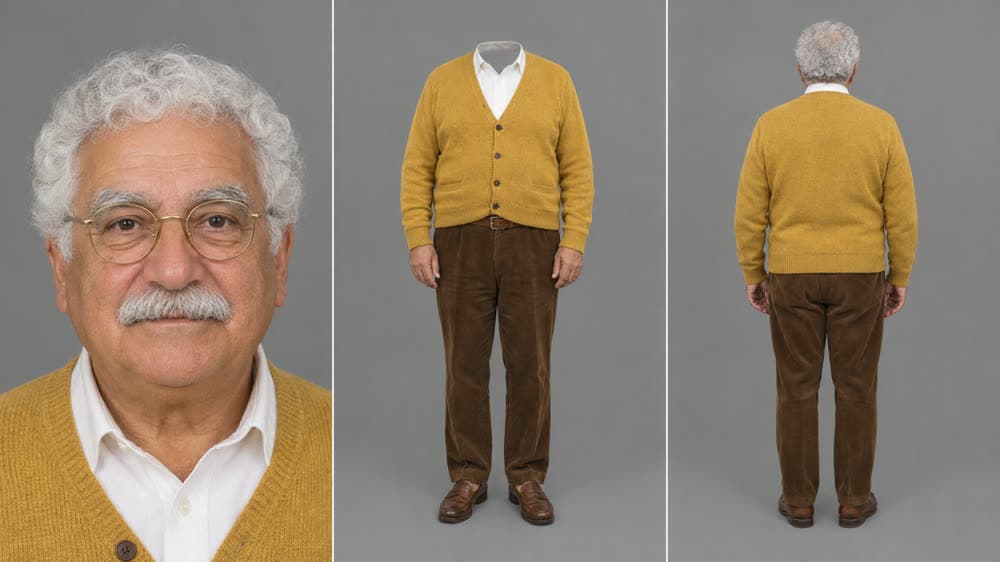
The photo's frame is the outfit's frame.
The model read the three-panel sheet as one person, not three. So if you have a character sheet, send it whole.
Can you say who becomes whom?
Yes, in one sentence. Without a prompt, the first photo replaces the leftmost person, the second the next. We reversed that on purpose: the nun was attached first and the drummer second, and the prompt said the nun becomes the man on the right. She did. The arm wrestle, the hand slam, the table and the skyline are the source's; the habit and the studded vest are the photos'.


@Image1 becomes the man on the right, @Image2 becomes the man on the left. Keep everything else the same.
Name the photos by their tags, @Image1 and @Image2, and say where each one goes. That is the whole prompt.
Does the new person still say the words?
Yes. The sound is not remade; it comes back unchanged. The new face is animated to it: in the desk clip, the nun's lips open and close where the man's did, and his smile and nod land on her at the same moments. The voice is still his, which is the point and the joke.
Does the seed bring back the same clip?
Yes. A seed is the number a run starts from; send the same one again and you ask for the same result. We sent the dance with the grandpa photo and the same seed twice, and got the same clip back, frame for frame. So a recast you like can be made again, and a seed is worth keeping.
Does it work with a real photo?
Yes. Every other photo in this test was generated, so we sent one phone selfie. fal accepted it, and the real face went through the whole dance. The white t-shirt came from the photo; the shorts were invented.

A real photo is also where the enhance realism switch earns its name. fal describes it as better skin texture and blending, and on a close-up that is what we saw: with it on, the face took the warm lamp light of the room; with it off, the face kept the flat light of the selfie and sat on the scene like a sticker. On a wide shot, the two were just different takes. Tonpit leaves it on.
Putting a person into footage they were not in needs their permission. Tonpit's terms say so, and so should yours.
How much does H3 Max Recast cost, and how long does it take?
In Tonpit, 45 credits per second of output at 720p and 68 at 1080p, a credit being one cent: $2.25 for a five-second clip at 720p, $3.38 at 1080p. Photos and the prompt cost nothing. Each five-second recast took 84 to 123 seconds from pressing generate to having the file. The ten paid recasts of this test came to about $24, plus $4 for the source clips.
Where does H3 Max Recast fail?
At the clip's length, at crowds, and at what the photo does not show.
- Short and long clips. Under five seconds or over thirty is refused before anything is charged. A shot longer than fifteen seconds inside the clip fails at fal after you have paid, and the charge is refunded, so cut it first.
- Crowds. Untested: every source had one or two people, each with a photo.
- Clothes you did not show. See the photo section: crop the photo and you crop the outfit.
- Real footage is untested here. All three source clips were generated. Grain, a handheld camera and mixed light are the next test.
How does H3 Max Recast compare with editing the clip instead?
It is the only road that keeps your clip and takes a plain photo. The edit models re-render the scene from an instruction, with your clip as a reference, so the motion and the camera come back close but not the same. Prices in Tonpit for the same five-second clip:
| Road | What happens to your clip | Takes a photo of the person? | 5 s at 720p | 5 s at 1080p |
|---|---|---|---|---|
| H3 Max Recast | Kept as is; only the people change | Yes, any photo | $2.25 | $3.38 |
| Kling 4 edit | Re-rendered from your instruction, with the clip and photos as references | Yes | $1.42 | $2.12 |
| Seedance 2.5 edit | Re-rendered from your instruction, with the clip and photos as references | Only a Seedream 5 image or a Tonpit character; real faces are refused | $4.26 | $10.48 |
| Gemini Omni Flash edit | Re-rendered from your instruction alone; clips up to ten seconds | No | $0.75 | $1.13 |
So the choice is about the job, not the price. To put someone into a clip and change nothing else, Recast. To change what happens in the scene, an edit: Kling 4 when a photo must ride along, Omni when an instruction is enough.
What were the exact prompts?
The three source clips were made with FLUX 3 Max from these prompts. The only recast prompt was the one sentence in the two-people section; every other recast was sent without one.
The kitchen dance (runs 1, 2, 4, 5, 7 and 9):
A young woman dancing alone in a sunlit kitchen, full of joy, like nobody is watching.

Subjects:
A — woman, mid-twenties, long curly auburn hair in a loose ponytail, white t-shirt, light-blue jeans, white sneakers, in the middle of the kitchen floor

0.0–5.0s — one continuous shot, no cuts. Wide shot from across the kitchen, static camera at chest height, her whole body in frame from head to shoes the entire time, never cropped. She dances energetically to music: a hip sway, a spin on one foot, arms thrown up, a little shimmy, then a big laughing pose on the last beat. Nobody speaks.

Scene: morning, warm sunlight through a window on the left, white cabinets, a wooden table with a bowl of oranges, soft warm shadows
Style: shot on 35mm, f/2.8, Kodak Vision3 250D, low contrast, fine grain, natural color
Ambience: quiet kitchen, birds faintly outside
Effects: sneakers squeaking on the tile floor
Music: an upbeat funky disco track playing from a small speaker, clearly audible
No on-screen text or subtitles.
The arm wrestle (run 3):
A boardroom arm-wrestling match: two executives in dark suits, sleeves rolled up, locked in an arm wrestle across a long glass boardroom table, a city skyline through the windows behind them.

Subjects:
A — man, early forties, short dark hair, clean-shaven, navy suit, white shirt, tie loosened, on the left side of the table
B — man, late thirties, blond slicked-back hair, light stubble, charcoal suit, white shirt, on the right side of the table

0.0–5.0s — one continuous shot, no cuts. Medium two-shot from the end of the table, static camera at table height. Their gripped hands shake in the middle, A slowly forces B's arm halfway down, both faces straining, B's free hand slams the table. Nobody speaks.

Scene: daytime, bright cool window light, glass and steel, cool shadows
Style: shot on 35mm, f/2.8, Kodak Vision3 250D, low contrast, fine grain, shallow depth of field
Ambience: quiet office hum, distant traffic through the glass
Effects: grunts of effort, a palm slapping glass, a chair creaking
Music: none
No on-screen text or subtitles.
The desk line (runs 6 and 8):
A man talks straight to the camera in a cozy home office, like a vlog.

Subjects:
A — man, early thirties, short brown hair, trimmed beard, dark-green crewneck sweater, seated at a desk, centered in frame

0.0–5.0s — one continuous shot, no cuts. Medium close-up, static camera at eye level, his face and shoulders clearly lit, lips plainly visible the whole time. He looks into the lens and says, clearly and with a smile: "Okay, here's the thing. Nobody tells you this part, but it changes everything." He nods once at the end.

Scene: evening, a warm desk lamp, bookshelves softly out of focus behind him
Style: shot on 35mm, f/2, Kodak Vision3 500T, low contrast, fine grain, shallow depth of field
Ambience: quiet room tone
Effects: none
Music: none
No on-screen text or subtitles.