Gemini Omni Flash 1.2 is the new version of Google's video model, released November 5, 2026: it makes clips of 3 to 15 seconds with sound, from words, from pictures, or by editing a clip you already have. In Tonpit it costs about 18% less than version 1.1 at 720p. In our nine test films it followed a timed script and kept faces the same, but big ideas came back smaller.
Tested November 6, 2026, in Tonpit. Prices are in credits; a credit is one cent. Every film is the take as it came out, compressed for this page. This is one person's judgment on a few takes, not a benchmark.
What can Gemini Omni Flash 1.2 do, in short?
- Clips of 3 to 15 seconds, up from 10.
- Lower prices in Tonpit: about 18% less at 720p and above, 9% at 360p.
- Sound is always on.
- It can work from pictures. One to open on (a start frame), one to land on (an end frame, which limits the clip to 10 seconds), or up to 6 reference images that show who or what must appear.
- It edits clips you already have, if they are under 15 seconds.
- Two shapes only: wide (16:9) or vertical (9:16).
- Four quality levels: 360p, 720p, 1080p and 4K. The top two are enlarged from the 720p picture.
- Version 1.1 is ending. From December 3, 2026, Google sends every request for 1.1 to 1.2.
What did we make with it?
Nine films, for 1,235 credits, about $12, not counting retakes and the still pictures.
| Film | Made from | Settings | Credits | Landed | Missed |
|---|---|---|---|---|---|
| Hanging car | Words | 15 s, vertical, 720p | 185 | Everything on time, as written. | Asked for a white void, got a brighter room. |
| Teddy bear | An edit of the hanging car | 15 s, vertical, 720p | 184 | Car swapped, same timing and flinch. | The bear never vanishes. |
| Boy to old man | Start and end frame | 10 s, wide, 720p | 123 | The world moves, the oak grows. | The boy’s body stays small; the adult in between never appears. |
| Two people, four places | Six reference images | 15 s, vertical, 720p | 185 | Both people held through all four. | The desert came out as red-sky mountains. |
| Lioness | Words | 8 s, wide, 720p | 99 | Ends on her look into the camera. | |
| Lioness, vertical | An edit of the lioness | 8 s, vertical, 720p | 99 | A true vertical clip, no black bars. | She slides out of frame at the end. |
| Through the eye | Words | 15 s, vertical, 360p | 62 | Four trips through her eye. | Her face changes a little from place to place. |
| Home studio | Start frame and a written speech | 15 s, vertical, 1080p | 277 | Looks like real phone footage, and the lip-sync is excellent. | |
| Giant cat | Words | 5 s, vertical, 360p | 21 | All of it, on the first try. |
How much does Gemini Omni Flash 1.2 cost?
In Tonpit, 12.3 credits per second at 720p: 99 credits for 8 seconds, down from 120 on version 1.1. Sound and reference images cost nothing extra, and an edit costs the same as a new clip of that length.
| Quality | Credits per second | 8 seconds | 15 seconds | Version 1.1, per second |
|---|---|---|---|---|
| 360p | 4.1 | 33 | 62 | 4.5 |
| 720p | 12.3 | 99 | 185 | 15 |
| 1080p | 18.4 | 148 | 277 | 22.5 |
| 4K | 36.9 | 295 | 553 | 45 |
Does it follow a timed script?
Yes, closely. We wrote the hanging car second by second and the film keeps the clock: the cable slips at 4 seconds and the car is gone by 10. Where we asked for cuts at 4, 7 and 11 seconds, they landed at 4.00, 6.96 and 10.96.
What it would not do is make the whole room disappear. For second 9 the prompt said:
In that instant the car, the cable and the warehouse are gone. He sits on the stool with his laptop in a completely empty pure white space, soft even light, no horizon.
The car and the cable went. The warehouse stayed, a little brighter. A retake with stronger words did worse: the car came back at the end. Two films further down went the same way: the red desert that came out as mountains, and the boy who was meant to grow up.
It keeps your timing and softens your biggest idea.
Can it edit a clip you already have?
Yes, with one sentence, and the rest of the clip stays as it was. For the teddy bear at the top of this post we sent:
Replace the hanging car with a giant pink teddy bear of the same size, hanging from the same cable. Keep everything else the same.
The man, the room and his flinch at 5 seconds came back at the same moments. In the original the car vanishes at 10 seconds. The bear never does; it hangs there to the end. The sound came back too: measured against the original, it is the same recording, apart from about two seconds around that moment.
A full 15-second clip needs a small cut first. Edits take clips under 15 seconds, and a 15-second clip measures 15.04 as a file. We cut ours to 14.92 seconds.
Can it turn a wide video into a vertical one?
Yes, if you ask in words; there is no setting for it. Our test film: a man sits frozen in a safari truck with a lioness beside him sniffing his ear. He whispers "I make launch videos in Tonpit. Not AI slop of lions eating men." and taps her on the nose.
We sent Make this video vertical, 9:16. Keep everything else the same. A 1280×720 clip came back 720×1280, no black bars, for 99 credits. It crops in closer rather than inventing new picture above and below. The crop follows the man, so at the end the lioness slides out of frame and her look into the camera is lost.
Does it keep people the same from shot to shot?
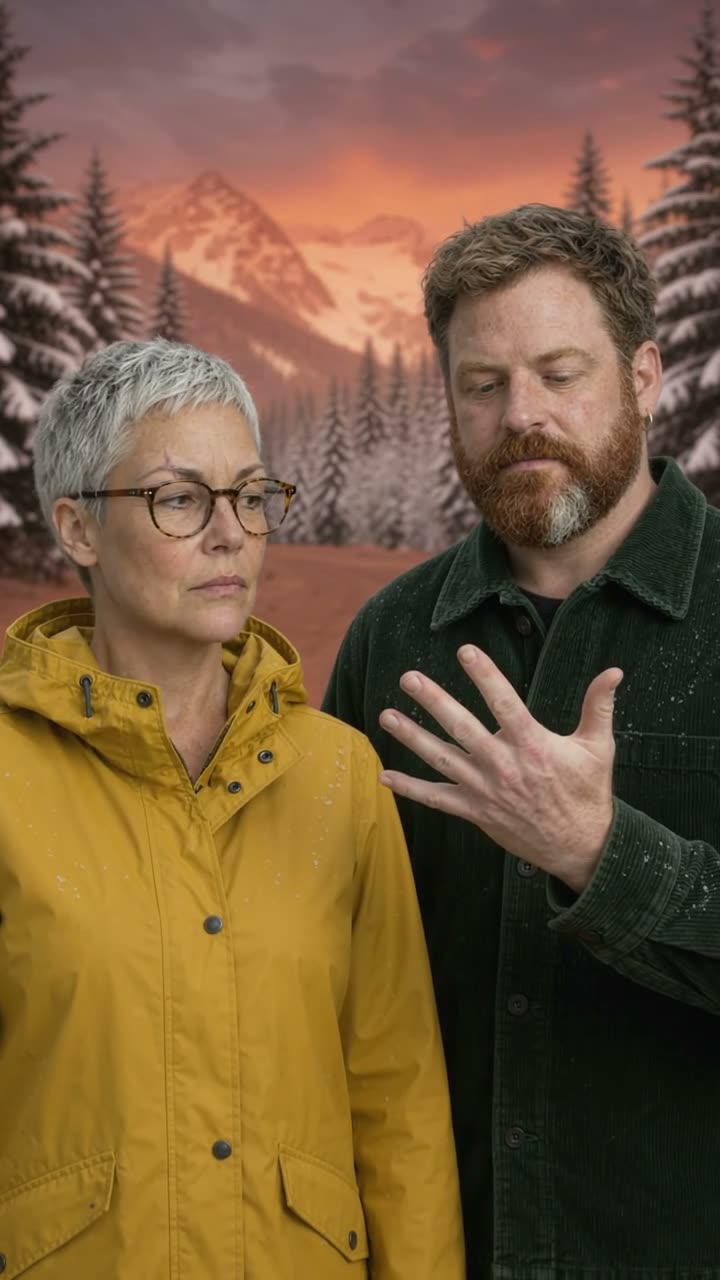
With reference images, yes. We gave it six pictures, three of a woman and three of a man, and asked for one film in four places. They stayed the same two people: her eyebrow scar and glasses, the white patch in his beard, the hoop in his left ear. The snow from the second place even stays on their coats. The place slipped, though: we asked for a red desert and got the peak and pines of the snowy road, under a red sky.
Without reference images, faces can drift. In the film through the eye, made from words alone, her face changes a little from place to place, though the camera did go into her eye four times and come out somewhere new.
Can it age a person between two pictures?
Partly. We gave it a boy of five to open on and the same person at 90 to land on, over ten seconds, the limit with an end frame. The world around him works: strangers rush past, a wedding goes by, the sapling grows into an oak. He does not grow up. His face turns old while his body stays small, so the adult in between never appears. The old man of the end frame does arrive at the end, matching the picture we gave it.
Does it look real, and do the lips match?
It can look real. From one still picture and a written speech, the home studio film looks to us like footage from a real phone, and the pause before her last line falls where the prompt put it. The woman does not exist: the still was generated too.
The lip-sync is excellent: across 15 seconds of speech, her lips stay with her words.
The cat is the opposite case: we asked for footage from a cheap old phone and got exactly that on the first try, at 360p, for 21 credits. When bad footage is the look, low quality loses you nothing.
How do you write a prompt for Gemini Omni Flash 1.2?
Like a script with a clock. We followed Google's published guide to the model: "single continuous shot" when you want no cuts, times like [0-2s], sound described in words, and what you do not want written as a sentence. Name reference images in plain words, as we did: "The woman shown in the first three reference images and the man shown in the last three". The whole prompt for the cat:
Shaky handheld footage from a cheap old phone, filmed from an apartment window at dusk, low resolution, soft focus, blown highlights. In a single continuous shot with no scene cuts. Across the street, a ginger cat the size of a two-storey house sits on the flat roof of an office block, one paw resting on a rusty rooftop water tank. It stares straight at the camera.

[0-2s] The camera zooms in jerkily. A tired man behind the camera says quietly: "Don't. Don't you dare."
[2-4s] Never breaking eye contact, the cat slowly pushes the tank until it tips over the edge and drops out of sight.
[4-5s] A distant crash and car alarms. The cat keeps staring.

No people in the street. No music. No subtitles, no on-screen text, no timestamp.