FLUX 3 Max is a faster version of the FLUX 3 video model, trained further by fal. Same prompts, same start and end frames, same keyframes, with sound, in about a tenth of the time, at the same price. We made nine clips with it. Dialogue, frames and keyframes all held. The one thing that did not work as advertised: the seed does not bring a clip back.
Tested November 1, 2026: six clips through Tonpit and three straight on fal. Every time and price here is from those jobs. Nine clips from four prompts, printed in full at the end.
What is new in FLUX 3 Max, in short?
- It is FLUX 3, trained further by fal. Released October 19, 2026, on fal only.
- About ten times faster. Around nine seconds of model time for a ten-second clip.
- Same price as FLUX 3.
- Same inputs. Text, a start frame, a start and an end frame, or up to ten timed keyframes. Five to twenty seconds, 720p or 1080p, sound on by default.
- Dialogue works. The character you name says the exact line.
- Two new settings. A seed, which does not reproduce a clip, and a reasoning level, which made no difference in our test.
- No draft mode. Cheap drafts that a later render finishes stay with FLUX 3.
- It may change under you. fal calls it a first version still in training, and there is no way to pin the one you tested.
On quality, Artificial Analysis's early ranking for image-to-video puts it ahead of FLUX 3 and level with MiniMax H3 and Seedance 2.5.
What did we run?
One world, a city standing on clouds, and one couple described the same way in every prompt. Four prompts: text alone with a spoken line, a start and an end frame, three keyframes over fifteen seconds, and a two-line dialogue to test the reasoning level. The five frames were made first, on GPT Image 2.5 Flare. Every clip is 16:9 with sound on.
| Run | What | Settings | Time | Cost | Landed | Missed |
|---|---|---|---|---|---|---|
| 1 | Prompt A, text only | 720p, 10 s | 40 s | $2.55 | Both shots, the cut, the line spoken, the film look. | The city on clouds came out as a foggy stone city with a bridge. |
| 2 | Prompt A again, with run 1’s seed | 720p, 10 s | 33 s | $2.55 | The same shots and line. | A different clip: another bridge, another crowd. |
| 3 | Prompt B, start and end frame | 720p, 8 s | 48 s | $2.04 | Opens on the start frame, ends on the end frame, doors and footsteps in the sound. | |
| 4 | Prompt C, keyframes at 0, 7 and 15 s | 720p, 15 s | 68 s | $3.83 | Passes through all three frames on time; the couple holds. | |
| 5a | Prompt D, text only | 720p, 10 s, high | 47 s | $2.55 | All three shots, both lines, no subtitles. | One extra word in the second line. |
| 5b | Prompt D on fal, run 5a’s seed | 720p, 10 s, high | 32 s | $2.55 | Both lines word for word. | A different clip from the same seed. |
| 5c | Prompt D on fal, same seed | 720p, 10 s, low | 12 s | $2.55 | Both lines word for word, the same shots as high. | A different clip again. |
| 5d | Prompt D on fal, same seed | 720p, 10 s, low | 34 s | $2.55 | Both lines, the same shots. | Differs from 5c too: low does not replay either. |
| 6 | Prompt A at 1080p, run 1’s seed | 1080p, 10 s | 51 s | $4.35 | Full 1080p delivered. | Another clip. |
Time is from sending the prompt to having the file. Cost is what the clip costs in Tonpit; runs 5b to 5d were made straight on fal and are priced here as they would be in Tonpit.
How fast is FLUX 3 Max?
About nine seconds of model time for a ten-second clip at 720p. The wait is longer than that: our three runs straight on fal took 12, 32 and 34 seconds from sending to file, and the difference was the queue. In Tonpit, which also downloads and stores the clip, a ten-second clip was ready in 33 to 51 seconds and the fifteen-second one in 68.
How much does FLUX 3 Max cost?
In Tonpit, about 25 credits per second at 720p and 44 at 1080p, a credit being one cent: $2.55 for a ten-second clip at 720p, $4.35 at 1080p. Sound is included and the reasoning level does not change the price. FLUX 3 costs the same. The nine clips of this test came to about $25.
Does FLUX 3 Max generate dialogue?
Yes, and the character you name says it. Both dialogue prompts came back with the lines on the right face. Written down by a transcriber, they read "I told you we'd beat the fog" and "Three days up here. You still haven't seen the ground", one word added to each; the three runs straight on fal said the rooftop lines word for word. Wind, doors and footsteps came through where the prompt asked for them. No subtitles appeared; every prompt ended with No on-screen text or subtitles.
Do start frames, end frames and keyframes work in FLUX 3 Max?
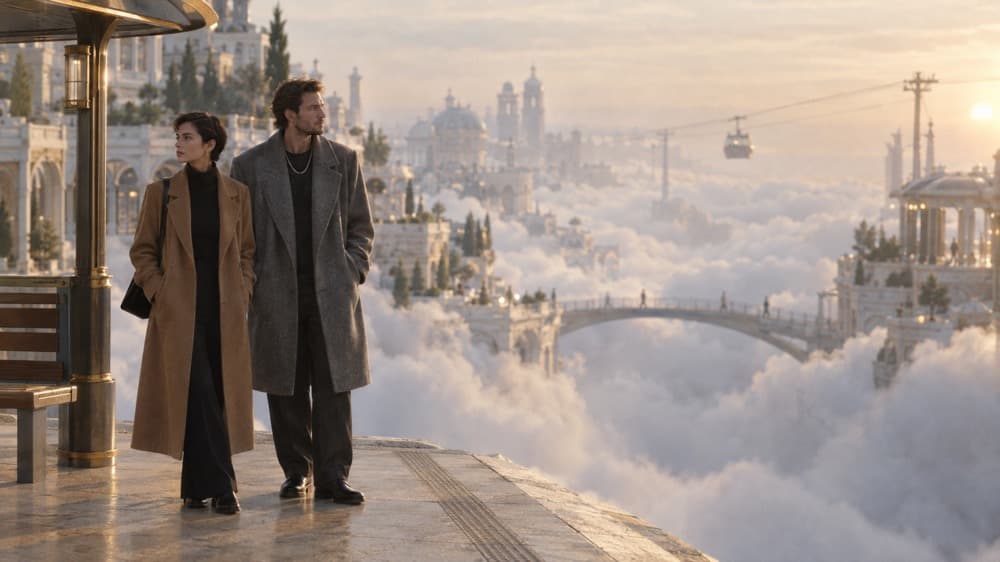
Yes, as on FLUX 3. The tram clip at the top opened on its start frame and closed on its end frame. The keyframes clip took three frames pinned at 0, 7 and 15 seconds and passed through each on time, with the couple's faces, hair and coats stable the whole way.
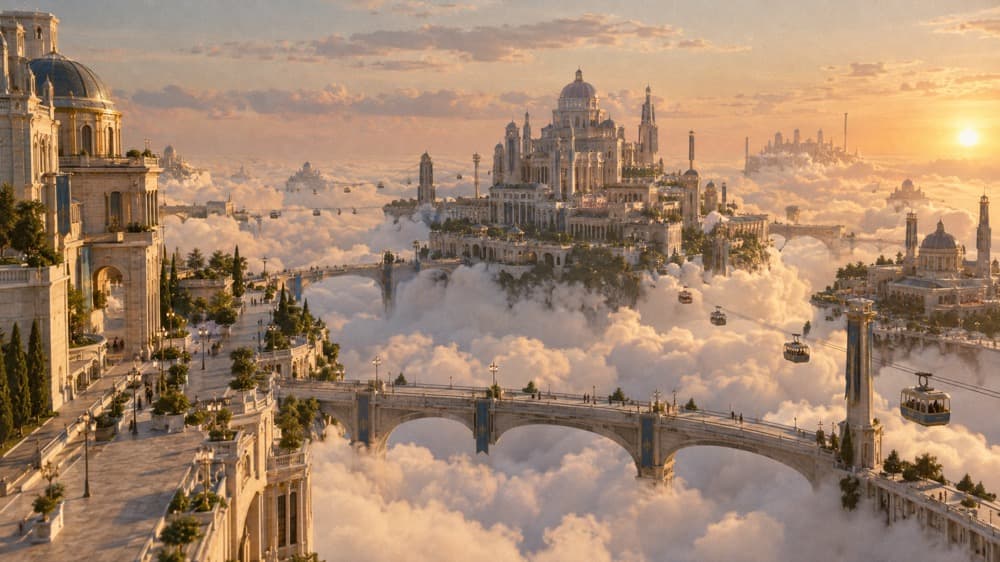
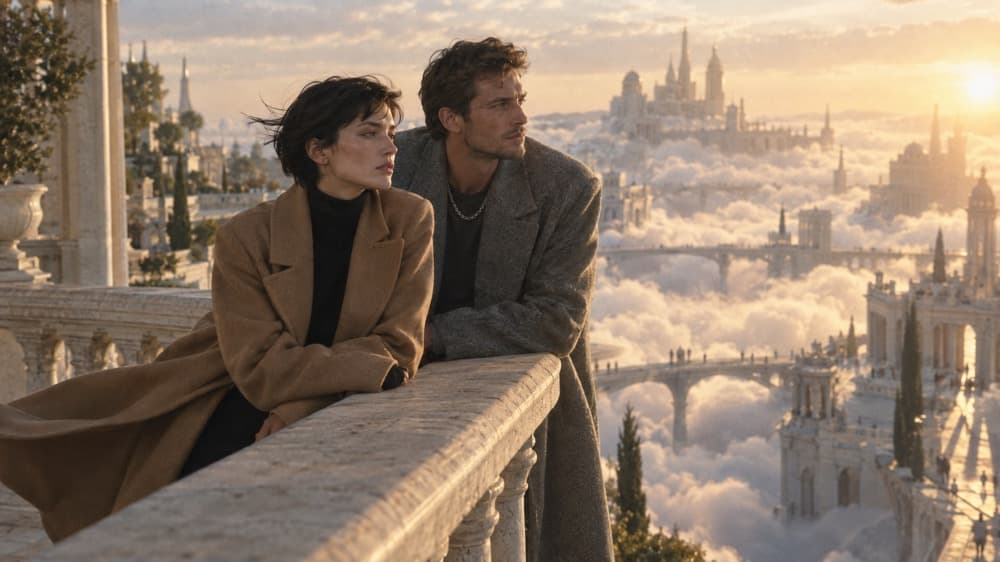
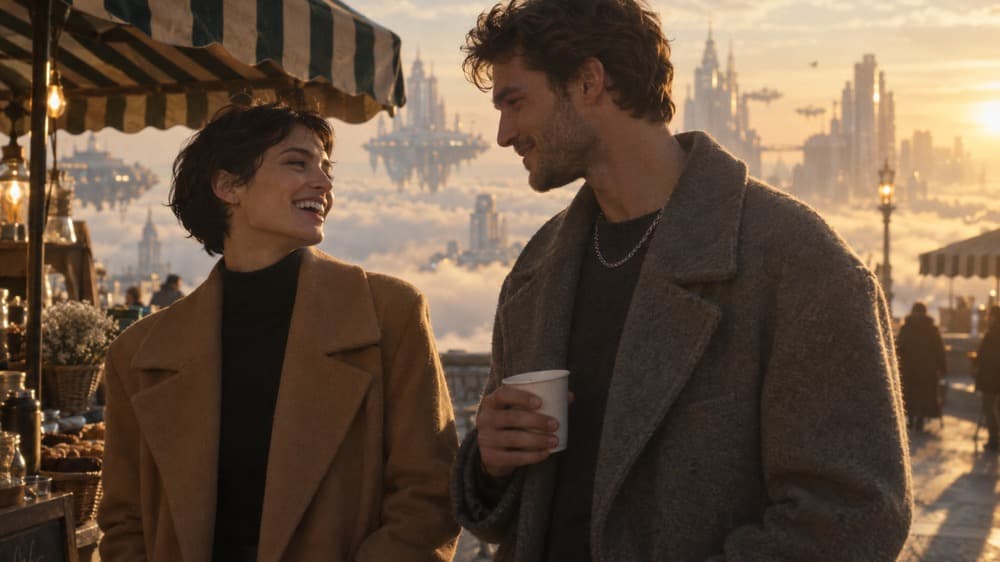
One lesson: a world this unusual needs a frame. From text alone, the city on clouds came back as a foggy stone city with a bridge (run 1, below). Both clips that started from a frame lived in the cloud islands. The images are frames of the video, not a reference for who the character is; FLUX 3 has no such reference.
Does the seed bring back the same clip?
No. FLUX 3 Max accepts a seed and returns one with every clip, and on most models that means you can re-run a prompt with its seed and get the same clip back. Here you get a new one. We tried three times with the same prompt and seed, at both reasoning levels, and once more at 1080p: the same shots and lines each time, a different clip each time. A frame-by-frame similarity score put the pairs a little above two unrelated clips of the same prompt, never near identical.
The seed is there, but it is not a replay button.
So when a take comes out right, keep it. There is no way to make it again, and a re-run costs a full clip.
Does the reasoning level change the result?
Not that we could see. The setting has two values, low and high, and fal describes high as more effort on the prompt and slower. We ran the rooftop dialogue at both, same seed. Both kept all three shots and both lines word for word, and the model's own time was the same nine seconds. The price is the same either way. We left it on high, the default. Judge for yourself:
How do you write a prompt for FLUX 3 Max?
The same way as for FLUX 3, following Black Forest Labs' prompting guide. Write the clip like a shot list, in order: the framing and one camera move per shot, hard cut between angles, the exact words in quotes with who says them and how, then the scene, the look and the sound on their own lines. What carried this set:
- Describe the people once, the same way every time. Three or four fixed features each, pasted into every prompt, kept the couple recognizable across five frames and four prompts.
- Describe the look as a camera, not as adjectives. One line, repeated word for word, carried the whole set: shot on 35mm, f/2.0, Kodak Vision3 250D, low contrast, fine grain, shallow depth of field, fashion campaign framing.
- With frames, write only the motion and the sound. Prompt B never describes the tram stop or the seats; the frames do.
- With keyframes, say what must stay the same. Prompt C names the faces, the coats, the stone and the light, and none of them drifted.
- Write the sound. The background, the effects tied to things you can see, music or none, and how the voices should sound.
What were the exact prompts?
All four carry the style line. A and D carry the couple's description; B and C leave the couple to the frames, whose prompts carry it.
Prompt A, text only, 10 s (runs 1 and 2 at 720p, run 6 at 1080p):
Morning rush in a city built on clouds: avenues of pale stone float on dense white cloud banks, footbridges span the gaps between them.

Subjects:
A — woman, late twenties, dark cropped hair, sharp cheekbones, long camel coat over a black turtleneck
B — man, early thirties, tall, light stubble, oversized grey wool coat, silver chain

0.0–4.0s — wide shot, slow push in. A and B walk toward camera across a stone footbridge; cloud mist rolls past their ankles, commuters pass behind them.
hard cut
4.0–10.0s — medium shot, handheld, slight drift. They stop at the bridge's edge and look down into the clouds. A, calm and amused: "Told you we'd beat the fog."
B grins and pulls his collar up.

Scene: early morning, low golden sun through haze, pale stone, white cloud, warm skin tones, cool shadows
Style: shot on 35mm, f/2.0, Kodak Vision3 250D, low contrast, fine grain, shallow depth of field, fashion campaign framing
Ambience: wind, a distant tram bell, muffled street murmur
Effects: footsteps on stone, coat fabric moving
Music: none
Delivery: close and dry, conversational, no announcer delivery
No on-screen text or subtitles.
Prompt B, start and end frame, 8 s(run 3). The two frames came first, each frame prompt carrying the couple's description and the style line, then:
Start frame: A and B standing at a tram stop on the edge of a cloud island, waiting; a cable tram far off in the haze behind them; early morning golden light; wide shot, both full-length, looking off-frame left.

End frame: A and B seated inside the cable tram, side by side at the window; the cloud city passing outside, pale stone and white cloud; A looking out, B looking at A; medium shot from across the aisle.
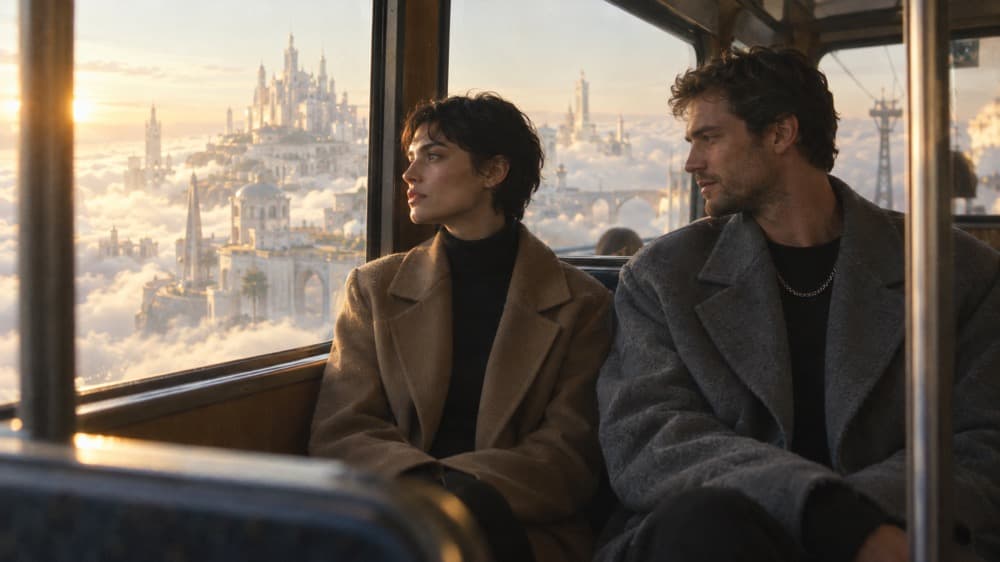
A and B wait at the tram stop as the cable tram glides in from the haze and stops; they board, and the camera follows them inside to their seats by the window as the tram pulls away over the clouds.

0.0–3.0s — wide shot, static. The tram arrives and its doors open.
hard cut
3.0–8.0s — handheld, following. They step in and sit; the city slides past the window.

Scene: early morning, low golden sun through haze
Style: shot on 35mm, f/2.0, Kodak Vision3 250D, low contrast, fine grain, shallow depth of field, fashion campaign framing
Ambience: cable hum, wind, a soft door chime
Effects: doors sliding, footsteps on the tram floor
Music: none
No on-screen text or subtitles.
Prompt C, keyframes, 15 s (run 4). Three frames, pinned at 0, 7 and 15 seconds:
0 s: Wide establishing view of the cloud city at golden hour: avenues of pale stone on white cloud banks, footbridges, cable trams, tiny figures; no people in the foreground.

7 s: A and B on a stone balcony over the clouds, leaning on the rail, wind in her coat, the city behind them; medium wide shot.

15 s: A and B at a market stall under a striped awning in the haze, B holding a paper cup, A laughing; close medium shot.
A day in the cloud city, following A and B from a view over the rooftops to a balcony over the clouds and on to the market.

0.0–7.0s — slow aerial drift forward over the avenues toward one balcony.
hard cut
7.0–15.0s — medium wide, slow push in on A and B at the rail; then handheld as they walk into the market and stop at the stall.

Keep fixed for the whole clip: A's and B's faces, hair and coats; the pale stone and white cloud of the city; the golden-hour light.

Scene: late afternoon, golden hour, long shadows, haze
Style: shot on 35mm, f/2.0, Kodak Vision3 250D, low contrast, fine grain, shallow depth of field, fashion campaign framing
Ambience: wind, market voices, a tram bell
Effects: footsteps, the awning flapping
Music: none
No on-screen text or subtitles.
Prompt D, text only, 10 s (runs 5a to 5d, at high and at low):
Night in the cloud city: a rooftop bar on the edge of a cloud island, string lights, the lit avenues below through the haze.

Subjects:
A — woman, late twenties, dark cropped hair, sharp cheekbones, long camel coat over a black turtleneck
B — man, early thirties, tall, light stubble, oversized grey wool coat, silver chain

0.0–3.0s — close-up on A, static. A, low and dry: "Three days up here."
hard cut
3.0–6.0s — close-up on B, static. B, amused: "Still haven't seen the ground."
hard cut
6.0–10.0s — two-shot from behind, slow pull back. They look out over the lit clouds; neither speaks.

Scene: night, warm string lights, cool blue haze below, deep shadows
Style: shot on 35mm, f/2.0, Kodak Vision3 250D, low contrast, fine grain, shallow depth of field, fashion campaign framing
Ambience: wind, glasses, far-off music from below
Effects: none
Music: none
Delivery: close and dry, conversational, no announcer delivery
No on-screen text or subtitles.